Some experiences pass through us and vanish. Others take hold, quietly becoming part of how we think and decide. I have spent two decades working on that difference, mostly inside education, where the failure to make experience last is easiest to see and hardest to fix.
Most reform adds. More content, more tools, more measures, more credentials. The harder question is what must be stripped away before learning can begin to leave a trace.
I do not treat digital learning as a matter of moving content from one container to another. The deeper problem is older than technology: learning is often designed to end cleanly — completed, recorded, certified — without becoming part of the learner’s future judgment.
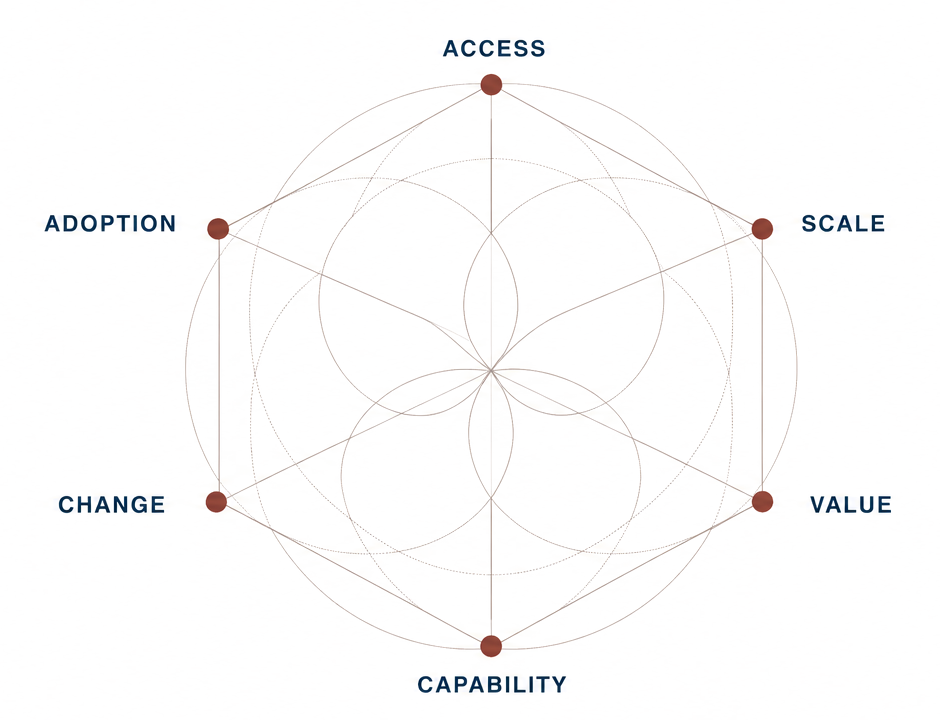
My work begins by questioning the inherited centers of the system.
Designing learning models where governance, faculty adoption, quality assurance, technology, and learner experience must work together.
Building scalable learning experiences where access, progression, engagement, and completion cannot depend on personal facilitation alone.
Designing learning where relevance, transfer, evidence of skill, and time constraints matter more than exposure to content.
Working where platforms, data, content, pedagogy, and institutional culture meet — and where technology alone cannot solve the problem.
نظرية الارتداد is an inquiry into the fate of the completed act. It asks why some actions end without trace, while others return as a quiet force that reshapes perception, judgment, and future action.
A space for thinking aloud in Arabic about the human being, experience, learning, institutions, and what remains after things appear to be over.
استمع إلى أثرA space for thinking aloud in Arabic about the human being, experience, learning, institutions, and what remains after things appear to be over.
استمع إلى أثرCompletion is not formation.
What takes hold, and what simply passes through?
I have spent more than twenty years building learning systems, digital platforms, content strategies, and educational experiences. But the question that kept returning was never only about education.
It was this:
What remains after an experience ends?
For years, I approached this question through education and technology. I hosted conversations on educational technology, worked on the future of learning, studied attention, digital behavior, adaptive systems, and the changing role of institutions. Each path revealed something important, but none of them was enough.
The real question was deeper.
Why do some experiences pass through a person without leaving a trace, while others quietly reshape the way they see, decide, and act? Why does so much learning end successfully on the surface, yet fail to become part of the learner? And what happens to an action after it is complete?
This question gradually became the center of my work.
Today, my writing, speaking, podcasting, and institutional work move around one idea: learning is not the transfer of content, but the formation of the human being through meaningful experience.
My current book project explores this through what I call The Afterhold: a theory of what remains active after an action is complete, and why some experiences continue to shape us while others pass through without taking hold.
This website brings together the different layers of that work: institutional practice, public writing, podcast conversations, and the longer intellectual project behind them.
At the center of all of it is a single concern:
What takes hold, and what simply passes through?